The Waiting: An Advent Meditation

The Advent Season is actually all about waiting. Waiting for the light of the world to come. Waiting for a breakthrough in this sinful world. Waiting for hope to come in the midst of experiencing pain. Waiting for Jesus.

  • Mary & Joseph waited for nine months to see their newborn baby
  • Zechariah and Elizabeth waited tirelelssly into their old age to have a child. And then Zechariah had to wait around until he saw baby Jesus to be able to speak again!
  • Centuries of prophets and believers before us waited for the coming Messiah and salvation of the Lord.
  • Simeon and Anna, two devout individuals who spent years in the Temple in Jerusalem, faithfully waiting and praying for the arrival of the Messiah, recognizing baby Jesus when he was presented.

Waiting can make us feel really uncomfortable. 

There 2 realities about waiting:

1.) Waiting brings self-examination. It is NOT a passive action. Waiting does not mean stalled, it means stillness. There is activity in being still. Anybody who stops and waits for a moment knows there is activity in being still. Where is the activity? OUR HEART. OUR MIND.

Waiting forces us to be present to the activity of our mind and heart. This is why people so often hate waiting. What do we automatically do when waiting in line at the store or sitting on the train? Phone. Distract. Disassociate. Being present to our heart and mind can be scary because: 1.) There are things we don’t like about ourselves, 2.) We are discontent with how our life is going, 3.) There is pain and disappointment we are avoiding feeling.

But there is good news. There is light in the midst of that discomfort and pain.

2.) Waiting brings intimacy. Remember what was just said– waiting does not mean stalled, it means stillness. And the Lord OFTEN calls us into stillness with Him. And stillness, if we fully embrace it, can be an avenue for us to be fully present to the presence of God. Waiting gives us time to not only examine ourselves, but to actively examine who he is. We get the chance to turn our eyes to him, really look at him, and remember the Light of the World. We get to remember His character, strength, peace, love, and we get to HEAR his healing voice that calls out to us so gently.

It’s almost funny, because the Christmas season gets BUSIER, at least for me! Our calendars are filled to the brim. So in a time of craziness, noise, Christmas songs, lights… Let’s pause and wait just like Mary, Joseph, Zechariah, the prophets, David, and so many others have done.

1. Becoming Present

MEDITATION
Let’s take a moment to settle our bodies. You may want to place both feet on the floor, hands open on your lap.

Gently close your eyes.

There’s nothing you need to do right now. Nothing to fix. Nothing to perform.

Just to be here.

(Pause 30 seconds)

As we enter this time of waiting, we remember the words of Scripture:

“Be still, and know that I am God.”
(Psalm 46:10)

Stillness is not inactivity.
Stillness is attention.
Stillness is presence.

___________________

2. Noticing the Activity Within

As you sit in this stillness, simply begin to notice what is happening inside you.
Thoughts may come.
Emotions may surface.
Restlessness, peace, distraction, heaviness, longing.

There is no need to judge what you notice.
No need to push anything away.
Just notice.

Scripture tells us:

“For God alone my soul waits in silence.”
(Psalm 62:1)

Waiting brings us face to face with our own hearts.
And God is not afraid of what you find there.

(Pause 1 minute)

If something uncomfortable rises—
a disappointment,
a sadness,
a frustration,
a place of discontent—
simply acknowledge it.

You might quietly pray:
“Lord, I see this.”
“Lord, you see this.”

(Pause 1 minute)

___________________

3. Waiting Is Trust

Listen to these words:

“The Lord is good to those who wait for him,
to the soul who seeks him.
It is good that one should wait quietly
for the salvation of the Lord.”
(Lamentations 3:25–26)

Waiting is not wasted time.
Waiting is trust practiced slowly.

As you sit, imagine yourself placing whatever you are waiting for into God’s hands.
A situation.
A relationship.
A decision.
A breakthrough you long for.

You don’t need to explain it to Him.
He already knows.

(Pause 1 minute)

___________________

4. Turning Our Attention to God

Now, gently shift your attention away from what you are waiting for, and toward who you are waiting with.

Listen to this Scripture:

“I wait for the Lord, my soul waits,
and in his word I hope.”
(Psalm 130:5)

Bring to mind the character of God.
His faithfulness.
His gentleness.
His strength.
His nearness.

Advent reminds us that God does not rush past human pain— He enters it.

(Pause 1 minute)

___________________

5. Listening

The Bible says that we are all able to hear the voice of God.

In 1 Kings, we see that God speaks to Elijah through a gentle whisper. In order to hear someone whisper, it requires proximity. Jesus is close to you now. I think that’s why God came to Elijah in a whisper, to show that when he speaks, and does so intimately. Closely.

For the next few moments, we simply listen.
Not forcing words.
Not chasing thoughts.

If a gentle phrase, image, or sense of peace comes, receive it.
If nothing comes, that is okay too.
Waiting itself is the prayer.

(Long pause – 2 minutes)

___________________

6. Hope in the Waiting

Listen to these final words:

“But they who wait for the Lord shall renew their strength.”
(Isaiah 40:31)

Waiting renews us—not because the waiting is easy, but because God meets us there.

As we come to a close, let’s remember again the One for whom all those before us were waiting:

“For a child is born to us, a son is given to us. The government will rest on his shoulders. And he will be called: Wonderful Counselor, Mighty God, Everlasting Father, Prince of Peace. His government and its peace will never end.”
(Isaiah 9:6–7)

___________________

Closing Prayer

Lord,
Teach us to wait well.
To be still without fear.
To trust without rushing.
And to recognize Your presence with us
Amen.

We fast to FEAST

Listen to the whole sermon on fasting HERE [at 39:30]

This week, our church is entering a time of Prayer & Fasting—something we do every January and September to set aside space to seek God in a focused way. We’re encouraging our community to participate, but I want to extend the invitation to you as well! If you’d like to join us, you can download the 1-week Prayer & Fasting Journal (available in English and Spanish), which includes daily devotionals, scripture, and prayer points to guide you.

So why fasting? Fasting is not about dieting, punishing ourselves, or trying to earn God’s approval. Instead, fasting is about making space—setting aside one appetite so our spiritual appetite can truly feast. Hunger pangs or missed routines become reminders to turn our hearts back to God.

Fasting is depriving one appetite to feed another appetite.

And true fasting always leads to transformation. It draws us into God’s presence, softens our hearts toward others, and frees us to live more like Jesus.

Here’s the image God gave me as I prayed for this week: a huge banquet table overflowing with delicious things. Scripture, prayer, worship, fellowship—all of it is laid out before us. But more than the meal itself, the reward is the One sitting across the table.

The purpose of a spiritual meal is not to consume but to commune.

Whether you’ve fasted before or this is brand new, you’re invited. God has made Himself “findable,” and as we seek Him, He promises we will encounter Him!


We are Built for Safety

We all experience pain in life– some of it deep and long-lasting. The amazing part is that God created us with built-in systems to protect ourselves from pain. Think about our automatic physical responses (fight, flight, freeze). Studies show that our brains are creating neuro-pathways from infancy– reading out environment and creating behavioral patterns to help protect ourselves emotionally. We are built for a safe place. God, our creator, built us for safety! What does this tell us about Him? He cares for our protection. He cares about our hearts. Our emotions. Our wellbeing. 

But in our lives, we experience pain, suffering, betrayal, trauma, sin… And we begin to build up strongholds as a protection around ourselves. Out of our pain and suffering, we create seemingly “safe places” to protect us against future attack. We begin to form a BELIEF SYSTEM out of our hurtful experiences.

But if we never submit these belief systems to the Word of God, with the voice of God that speaks His truth… these strongholds, these safe places, actually become a PRISON. When we are no longer allowing our lives to be transformed by God’s truth and God’s voice, we are TRAPPED BY our own painful experiences.

Stronghold Definition: A place that has been fortified so as to protect it against attack. A place where a particular cause or belief is strongly defended or upheld

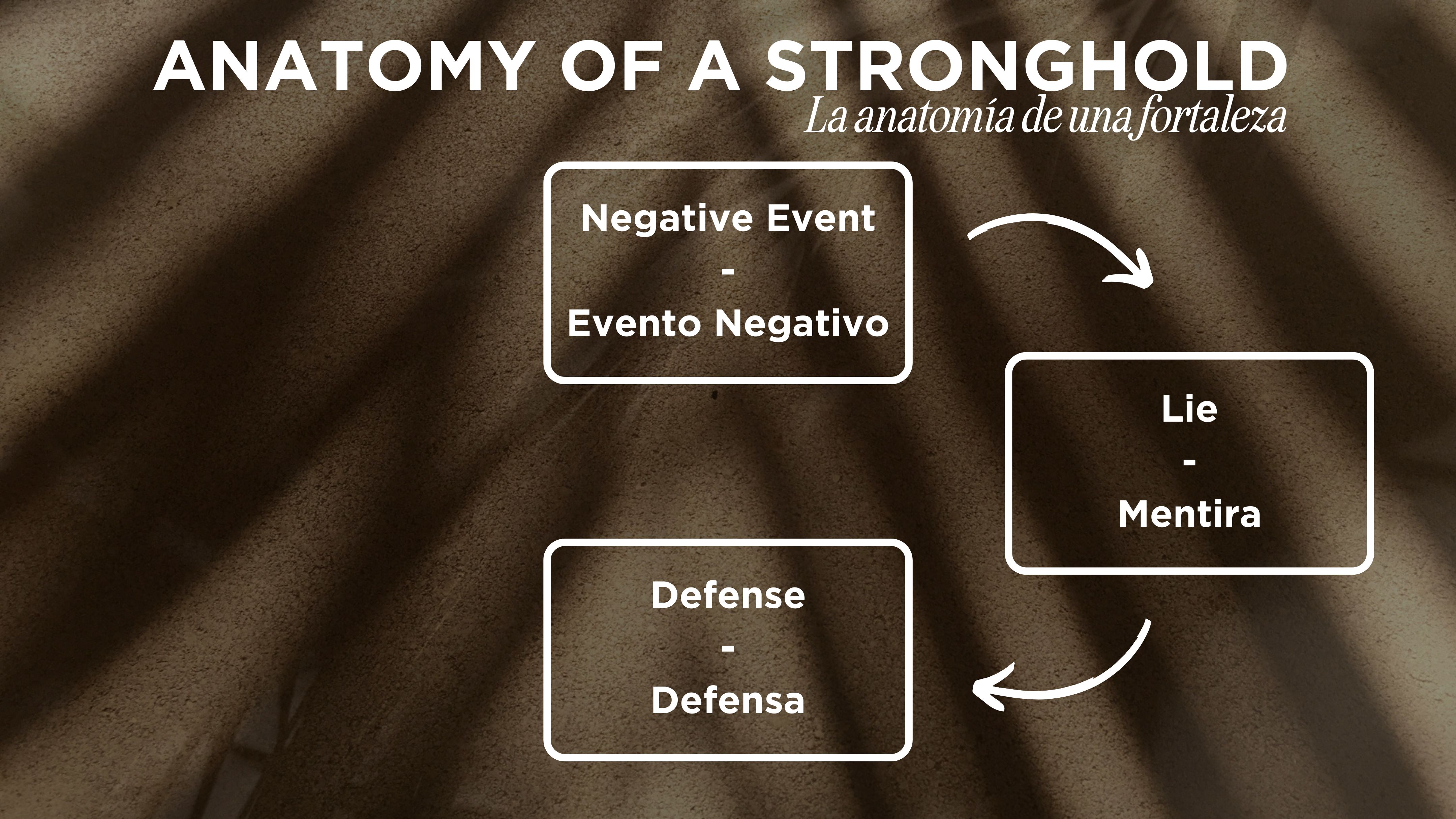
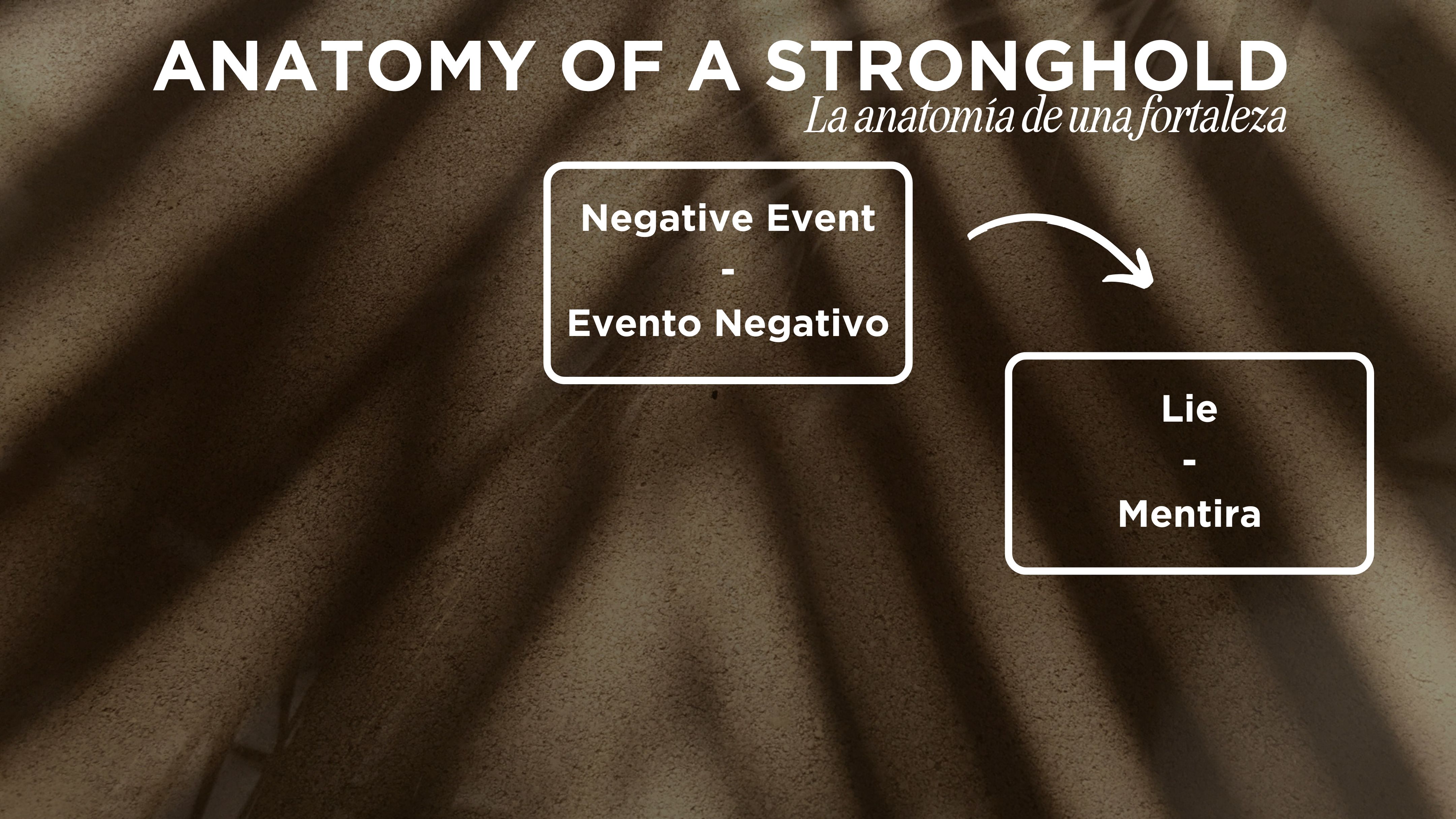
    HOW ARE STRONGHOLDS FORMED?

    It begins with a negative event…

    1.) NEGATIVE EVENT

    • Hurts & Trauma
    • “What I did not experience”
    • Generational Inheritance
    • Genetic Inheritance (epigenetics)
    • Spiritual Inheritance (3rd & 4th gen)
    • Family Culture

    Out of that negative event, we believe a lie. Why is it a lie? Because it does not line up with God’s truth. We create a “false truth” in our hearts– a “lens” to see the world by– in order to protect ourselves from any future hurt.

    2. LIE

    • “That’s the way it is in my life!”
    • Lies I believe about God
    • Lies I believe about others
    • Lies I believe about myself
    • Lies I choose & lies I inherit and embrace
    • Lies are the meaning assigned to the event

    And now. It’s time for us to build up a stronghold– a defense– to keep us from ever experiencing that pain again. Because WHO wants to experience that kind of pain again? “HOW can I protect myself from that?

    3. DEFENSE

    • Denial
    • Emotional Insulation
    • Repression
    • Anger
    • Projection/Externalization
    • Blame
    • Preemptive Rejection
    • Minimization
    • Withholding Trust
    • Busyness
    • Passive Aggression
    • Acting Out
    • Fantasy
    • Intellectualization
    • Rationalization

    The problem is, when we believe LIES about ourselves, about God, about others… and then we build up a DEFENSE to protect us from that pain in the future… We then REACT out of the stronghold, that defense… And people then REACT back to us…

    4. OTHERS REACT

    “I’ve been rejected by my best friend before… I can’t trust anyone. I’m going to withhold trust and vulnerability in the future to protect myself.” But happens when those future friendships sense that you’re withholding trust from them? That you’re distant? What happens when they feel like they can’t get close to you? They don’t draw close to you either… they pull away… And what happens when we receive their reaction? “See I KNEW I couldn’t trust anyone! Everyone always leaves me in the end.”

    And this is why the Anatomy of a Stronghold is a FULL CIRCLE. This is why sometimes we feel chained to our pain, and we can’t see a way out. This is how all of us fall to unhealthy patterns and feel imprisoned by our trauma. Remember what I said earlier– these strongholds, these supposedly “safe places”, actually become a prison. But there is GOOD NEWS.

    We have a loving God who views our pain and CARES FOR OUR HEARTS. He doesn’t just care for our transformation, He IS our transformation. He doesn’t just speak ‘nice thoughts’, but LIFE and TRUTH into our lives. There is a way out of that cycle of pain and lies, and that way out is Jesus. And He doesn’t just provide a safe place, He IS THE SAFE PLACE.

    Psalm 18:2
    The Lord is my rock, my fortress and my deliverer;
        my God is my rock, in whom I take refuge,
        my shield and the horn of my salvation, my stronghold.

    And it is out of that presence-driven relationship with Him that we find freedom and truth: NOT what the world tells us, our experience tells us, or what our pain tells us.

    2 Corinthians 10:3-5 (NKJV)
    “For though we walk in the flesh, we do not war according to the flesh. 4 For the weapons of our warfare are not carnal but mighty in God for pulling down strongholds, 5 casting down arguments and every high thing that exalts itself against the knowledge of God, bringing every thought into captivity to the obedience of Christ”

    There are arguments in our minds that go AGAINST the knowledge of God. And Jesus has provided freedom from those lies. The Message says, “We use our powerful God-tools for smashing warped philosophies, tearing down barriers erected against the truth of God, fitting every loose thought and emotion and impulse into the structure of life shaped by Christ.”

    Throughout our lives, we have accepted, consciously or unconsciously, knowledge that is not from God. There are lies written all over our hearts that are not aligned with the truth of Jesus. And we are CALLED to rip down those lies, those strongholds, and receive the true knowledge of God. We are called to agree with God’s voice, His Word. How do we do this?

    Verse #5 says: We take every thought captive, and we bend it to obey Jesus.


    REFLECTION:

    REPLACE THE LIES

    • Hear God: What is the lie?
    • Confess/Receive Forgiveness
    • Renounce (Engage Your Will)
    • Forgive
    • Hear God: What is your truth?
    • Believe
    • Confess

    NEW DEFENSE

    • Hear God: How have I put up a false defense?
    • Confess/Receive Forgiveness
    • Renounce (Engage Your Will)
    • Forgive 
    • Hear God: How will you defend me in the future?
    • Believe
    • Confess

    Shame ≠ Conviction

    SUNDAY SERIES: Gospel of John
    I have the privilege of teaching this past Sunday! We’re moving through the Gospel of John, and it has been a challenging, touching series so far. If you’d like to listen along, you can PODCAST the teachings. Below is just a snapshot of this past Sunday:
    This past Sunday, we explored one of the most powerful encounters in Scripture—Jesus and the woman caught in adultery (John 8:1-11). It’s a story of shame, conviction, and the radical grace of Jesus.

    Imagine this: A woman is caught in adultery, dragged into the temple courts, and thrown before Jesus. The religious leaders don’t care about her—they just want to trap Jesus. According to the law, she deserves death by stoning. But instead of engaging in their game, Jesus kneels down and writes in the dirt. When they press him, he finally speaks:

    “Let any one of you who is without sin be the first to throw a stone at her.”

    One by one, the accusers drop their stones and leave. Jesus turns to the woman and asks, “Where are they? Has no one condemned you?” When she says no, he replies, “Then neither do I condemn you. Go now and leave your life of sin.”This story reveals the heart of Jesus: He doesn’t condemn us—he sets us free.

    1.) Jesus Took Our Shame
    Every one of us has made mistakes. Shame tells us we’re unworthy, that we’ll never be good enough. But Romans 8:1 reminds us: There is now no condemnation for those who are in Christ Jesus. Jesus carried our shame to the cross so we wouldn’t have to. If you’re holding onto guilt from your past, it’s unnecessary weight. Jesus already paid for it—drop it and walk in freedom!

    2) Shame ≠ Conviction
    We often confuse these two. Shame attacks our identity (I am bad), while conviction speaks to our actions (I’ve done something bad). It’s the difference between “God is so disappointed in me” and “God has better for me”. Shame pushes us away from God; conviction draws us closer. Proverbs 3:11-12 reminds us that God disciplines us because he loves us. His goal isn’t to make us feel worthless—it’s to transform us into who he created us to be.

    3.) Jesus Cares Deeply About Transformation
    Jesus didn’t just forgive the woman; he called her to a new life.“Where are they? Has no one condemned you?” He wasn’t searching for an answer, he was getting HER to search for the answer. Think of ADam and Even hidden in shame in the Garden… “Where are you?” was a not a physical question, but an emotional one. Peter after his betrayal is eating breakfast with Jesus. Jesus asking Peter “Do you love me?” was a redemptive moment for Peter to reclaim His love for Jesus. To cover his shameful denials. 
    God does not ask questions for information, but for our transformation. 

    4.) It’s Not Our Job to Judge Others
    We love the part where Jesus shows grace to the woman—but we often forget that we’re also in the shoes of the Pharisees sometimes. Have you ever held a stone in your hand? Maybe not literally, but in your heart? Maybe you’ve judged someone silently, looked down on someone struggling with sin, or thought at least I’m not as bad as them. Romans 2:1 warns us: You may think you can condemn such people, but you are just as bad, and you have no excuse!  Yikes. Jesus reminds us that judgment isn’t our job. Our role is to bring people to Jesus for transformation, not condemnation. When we judge others harshly, it’s often because we haven’t fully received the grace of Jesus ourselves. If we’re still holding onto our own shame, we’re more likely to throw it at others. 

    Do you bring people to Jesus to be stoned, or do you bring them to Jesus to be transformed?So here’s the challenge—are you carrying shame Jesus already took? And are you still holding a stone in your hand, ready to judge? Let’s drop both and walk in the freedom he’s given us.

    Near Year, New Hope?

    It’s a new year! It’s interesting how the change of one number– 2024 to 2025— brings us a sense of hope and expectancy every year. We create a moment to pause, refresh, and dream for what could come. Maybe you have already made your New Years resolutions have been scouring Booking.com for trip ideas!

    We always start off the new year at ICB in 2 weeks of Prayer & Fasting— setting aside time and physical needs to hear from the Lord. We draw close in hopeful anticipation that He will also come close to us. We pray, ask, and wait for a “word of the year” or specific direction for where He is taking us. What plans do you have for me, Lord? What exciting moments will happen this year? Our anthem is the verse we know all too well (usually printed on mugs and corny t-shirt) Jeremiah 29:11 “For I know the plans I have for you,” says the Lord. “They are plans for good and not for disaster, to give you a future and a hope.”

    But what about those of us who cannot see a future and a hope? …the ones who have had their teeth kicked in repeatedly this past year? If you have not yet found yourself in a place of hope deferred, friend, your moment will come at some point. You’ll know it when you slowly begin to begrudge the always-optimistic worship songs (where has lament gone?). You’ll understand you are ‘there’ when talk of “hope & a future” is almost heard in a mocking tone. It’s not a fun place. It’s not a season you can intellectualize yourself out of. When all feels lost– who cares about a future?

    It is in this moment of hope deferred, of grief, that we can actually know God most intimately. When nothing else satisfies or fills us, when we cannot place any of our hope in a future, then the only place left is on our every-present, ever-close, ever- loving God. After all, God said through the prophet Jeremiah a few verses later “In those days when you pray, I will listen. If you look for me wholeheartedly, you will find me.” That is a guarantee. He is “findable”. He is close.

    If you are walking through a season of hopelessness and fear… if you find yourself not able to dream about a future… then I encourage you place your hope not on a future right now, but on the person of Jesus. Dream OF Him, so that one day soon after slowly healing with your Father, you may dream WITH Him.

    If you were to ask me for my New Years Resolutions, echoing Peter’s words in Acts 3:6 “I have nothing to give you. But I’ll give you what I have.” And what I have is an unwavering hope in the person and presence of Jesus. 

    Inexplicable Knowledge

    “Despite the obstacles, I felt a surprising level of comfort living in Uganda most of the time. I felt I was born to be there, and in many ways, living there seemed more natural than living in my native country. I had the unexplainable feeling, a settled knowing, that I was where I was made to be. I knew deep in my soul that I was home.” -Katie Davis

    I have never found a quote that sums up my burden for the Spanish people more than this one. Really, for 12 years, I have had this inexplicable, down-to-my-core knowledge that I was not meant to live in in the U.S. Every time I returned to any Spanish-speaking country, I felt more at home there than in my own country.

    God didn’t just “tell me” that he was calling me to be a missionary when I was 13 years old. It wasn’t a conversational exchange of facts about my future life. He reached deep down into the core of who I was, removed my own ambitions and dreams, and completely replaced them for His. It was like His passion for the Hispanic people became interwoven in my DNA. It’s not what I am to do– it’s who I am.

    That’s what makes this all so exciting. Most people think of being a “missionary” as tiring and sacrificial. Of course, this time will have its difficulties, and I will be stretched more than I ever have been. But the passions HE has given me are so much more substantial and breath-taking then any barrier that may weigh me down.

    IMG_2543